
Showing posts with label China. Show all posts
Showing posts with label China. Show all posts
Thursday, July 1, 2010
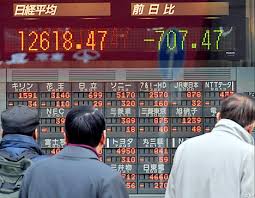
HONG KONG: Asian stocks slid on Thursday on weaker than expected economic data from China and global economic fears, despite growing business confidence in Japan.
Japan's Nikkei index closed down 191.04 points, or 2.04 percent, at 9,191.60, its lowest since November 2009.
The fall came despite a central bank announcement that Japanese business confidence had reached its highest level in two years, as the world's number two economy continues to pull out of its worst slump in decades.
"A global recession is unlikely, but it's obvious recovery momentum is slowing down," Norihiro Fujito, general manager at Mitsubishi UFJ Morgan Stanley Securities, told Dow Jones Newswires.
The index of sentiment among major manufacturers rose for a fifth straight quarter to one point in June from minus 14 in March, according to the closely watched Tankan survey.
Toyota fell 2.27 percent to 3,010 yen after it warned of a possible recall due to an engine fault in its top line Lexus and Crown sedans, adding to a litany of woes in the Japanese auto industry.
Mobile carrier Softbank tumbled 4.38 percent to 2,267 yen after its subsidiary Yahoo Japan was slapped with an additional tax payment order.
In Shanghai, Chinese shares closed down 1.02 percent as weak June manufacturing data weighed on sentiment, dealers said.
The Shanghai Composite Index, which covers both A and B shares, was down 24.58 points at 2,373.79 on turnover of 46.4 billion yuan (6.8 billion dollars).
China's Purchasing Managers Index fell to 52.1 in June from 53.9 in May, the National Bureau of Statistics said Thursday.
In Sydney, Australian stocks closed at their lowest in 11 months on the weaker than expected Chinese economic data and a soft lead from Wall Street, with the benchmark S&P/ASX200 index down 1.49 percent or 64 points at 4,237.5.
The broader All Ordinaries was down 62.1 points at 4,262.7.
"Unfortunately, the beginning of the new financial year was not enough to rid the market of the current bout of global uncertainty and risk aversion it is experiencing, with seemingly little in the immediate future to turn things around," said IG Markets analyst Ben Potter.
Resources stocks experienced a mid-afternoon bounce following reports that the government was nearing a tax compromise with major miners, but closed firmly lower, with Rio Tinto off 2.34 percent and BHP Billiton shedding 1.43 percent.
Singapore's Straits Times Index tumbled 0.53 percent to close at 2,820.35.
Casino operator Genting Singapore was up 0.86 percent at 1.18 dollars and Singapore Telecom was unchanged at 3.04 dollars.
Hong Kong was closed for a public holiday.
Japan's Nikkei index closed down 191.04 points, or 2.04 percent, at 9,191.60, its lowest since November 2009.
The fall came despite a central bank announcement that Japanese business confidence had reached its highest level in two years, as the world's number two economy continues to pull out of its worst slump in decades.
"A global recession is unlikely, but it's obvious recovery momentum is slowing down," Norihiro Fujito, general manager at Mitsubishi UFJ Morgan Stanley Securities, told Dow Jones Newswires.
The index of sentiment among major manufacturers rose for a fifth straight quarter to one point in June from minus 14 in March, according to the closely watched Tankan survey.
Toyota fell 2.27 percent to 3,010 yen after it warned of a possible recall due to an engine fault in its top line Lexus and Crown sedans, adding to a litany of woes in the Japanese auto industry.
Mobile carrier Softbank tumbled 4.38 percent to 2,267 yen after its subsidiary Yahoo Japan was slapped with an additional tax payment order.
In Shanghai, Chinese shares closed down 1.02 percent as weak June manufacturing data weighed on sentiment, dealers said.
The Shanghai Composite Index, which covers both A and B shares, was down 24.58 points at 2,373.79 on turnover of 46.4 billion yuan (6.8 billion dollars).
China's Purchasing Managers Index fell to 52.1 in June from 53.9 in May, the National Bureau of Statistics said Thursday.
In Sydney, Australian stocks closed at their lowest in 11 months on the weaker than expected Chinese economic data and a soft lead from Wall Street, with the benchmark S&P/ASX200 index down 1.49 percent or 64 points at 4,237.5.
The broader All Ordinaries was down 62.1 points at 4,262.7.
"Unfortunately, the beginning of the new financial year was not enough to rid the market of the current bout of global uncertainty and risk aversion it is experiencing, with seemingly little in the immediate future to turn things around," said IG Markets analyst Ben Potter.
Resources stocks experienced a mid-afternoon bounce following reports that the government was nearing a tax compromise with major miners, but closed firmly lower, with Rio Tinto off 2.34 percent and BHP Billiton shedding 1.43 percent.
Singapore's Straits Times Index tumbled 0.53 percent to close at 2,820.35.
Casino operator Genting Singapore was up 0.86 percent at 1.18 dollars and Singapore Telecom was unchanged at 3.04 dollars.
Hong Kong was closed for a public holiday.
Thursday, July 1, 2010 Comments
Tuesday, June 22, 2010
But that euphoria was checked as investors took a more considered view on the impact the move would have on economic fundamentals
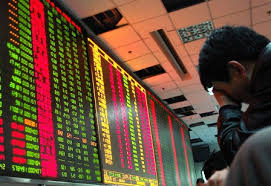
Hong Kong: Asian stocks retreated on Tuesday as investors booked profits a day after China’s weekend decision to give its currency more flexibility triggered a risk rally.
China’s move on the yuan had set off optimism that a stronger yuan would lift its purchasing power for foreign goods such as commodities, a boon to the global economy given the nation’s vast appetite for raw materials.
But that euphoria was checked as investors took a more considered view on the impact the move would have on economic fundamentals.
“The potential boost that might be given to consumption is likely to be subtracted from what will happen to exports,” said Emil Wolter, head of regional strategy at Royal Bank of Scotland.
“But the bottom line is that the market is making a huge deal of an insubstantial occurrence,” he said, adding that the yuan move had triggered a rally because it came after stocks registered their worst May in 12 years and at a time when there were large short positions.
“Sell in May and go away” is an old stock market adage which refers to the seasonal weakness in shares.
Beijing set the mid-point for the yuan’s daily trading range at a 5-year high on Tuesday, which gave the markets a brief respite from the selling but kept most indexes in the red.
On Tuesday, the MSCI index of Asia Pacific ex-Japan stocks was down 0.7%, hovering around the day’s lows. Losses in technology and resources provided the main drag.
China’s central bank set the yuan’s daily mid-point at 6.7980 against the dollar on Tuesday, the highest level since the yuan’s revaluation in July 2005, signalling it could allow the yuan to rise further.
Spot yuan rose to as high as 6.7900 in early trade, up 0.11% from the close on Monday, when it jumped 0.42%. But by mid-day it was down 0.17%.
Tuesday’s fixing initially reignited demand for riskier currency trades, with the Australian dollar and the euro jumping to the day’s high against the dollar. But that rise was short-lived and by noon the euro dipped 0.1% to $1.2298.
The Australian dollar rose as high as $0.8834, up from around $0.8765 just before the mid-point was announced. The Australian dollar then dipped to $0.8782, up 0.23% on the day.
Financial markets have also turned cautious ahead of Britain’s budget which will be announced later on Tuesday.
As the sovereign debt crisis spreads through Europe, rating agencies have warned even Britain’s triple-A status could be at risk if the finance minister’s plans to cut the record deficit are found wanting.
“Investors are growing more cautious on the view that the magnitude of the yuan’s new flexibility may not be as big as the market had earlier hoped,” said Lee Sun-yeb, a market analyst at Shinhan Investment Corporation in Seoul.
“It seems the market is taking a bit of breather following its recent sharp gains, as it nears the earlier high. Foreign buying has also halted.”
Japan’s Nikkei share average was down 1%.
The Korea Composite Stock Price Index fell half a% as foreigners dumped shares amid growing risk aversion. Foreign investors turned sellers on Tuesday snapping their seven-session buying streak.
Oil prices fell 0.8% toward $77 on speculation that a gradual appreciation of the yuan would have a limited impact on China’s petroleum imports in the short term.
China’s stock market, one of the world’s worst performers this year, managed to cling on to gains after the previous day’s surge. The Shanghai Composite Index was up 0.3%, after rising 2.9% on Monday to its highest close in 3 weeks.
And analysts expect more volatility ahead as the central bank’s move comes a day after it kept the mid-point unchanged.
“The authorities want to say they are showing a more hands off approach and more flexibility in the markets but the reality is they are introducing more intraday volatility in the market,” said Craig Chan, senior FX strategist at Nomura International.
Tuesday, June 22, 2010 Comments
The currency issue is likely to feature at the summit of the Group of 20 nations in Canada on 26-27 June, with many expected to seek further clarification from Beijing

Shanghai: China’s surprise move to relax currency controls ahead of this weekend’s G-20 summit buoyed global markets and sent the yuan to a five-year peak on Monday, but caution returned as analysts questioned how far Beijing’s new currency flexibility would go.
Stock markets surged after China loosened the yuan’s 23-month-old peg to the US dollar, easing a policy aimed at steadying its economy during the global downturn and paving the way for the currency to appreciate over the long-term as demanded by the United States and other major trade partners.
The unexpected move sent the yuan up 0.42% to 6.7976 per dollar on Monday, both the biggest daily gain and the highest close since China revalued the currency and introduced a managed float regime in 2005.
But initial optimism was quickly tempered with caution as officials, analysts and investors sought to determine the extent of China’s willingness to rethink policies which have turned it into a global export powerhouse.
“We’re obviously encouraged, but we’ll be monitoring the progress,” White House spokesman Bill Burton said in Washington. “Implementation here is going to be key, and so we’re just going to be keeping an eye on that.”
A senior US official, briefing reporters on condition of anonymity, said China’s gradual approach to yuan flexibility was a prudent step that could both manage expectations and deter massive speculative buying of Chinese assets.
The official said it was promising that China seemed ready to allow the exchange rate to respond to market forces, and that the test now was how far and how fast Beijing would permit the yuan to move.
US stocks, which had risen in step with world markets on the new yuan policy, succumbed to late-day selling and ended fractionally lower as an overall bearish tone undercut the early news out of China.
“Markets were unable to sustain that euphoria as they looked into the details,” said John Brady, senior vice president at MF Global in Chicago.
China’s central bank ruled out a one-off revaluation of yuan and suggested it was close to fair value -- a hint change will be gradual and may not satisfy critics who say China keeps its currency artificially undervalued by as much as 25 to 40 percent in order to gain unfair trade advantage.
The currency issue is likely to feature at the summit of the Group of 20 nations in Canada on 26-27 June, with many expected to seek further clarification from Beijing.
“Some countries will want to see more detail and perhaps even a schedule of some sort,” Canadian finance minister Jim Flaherty told reporters in New York on Monday.
Despite the Chinese move, G-20 leaders were expected to encounter further divisions over strategies to rebalance the global economy - a top G-20 goal since the global financial crisis of 2007-2009.
With pressure high from industry groups who want to see China’s huge trade surplus brought down fast, China’s sharpest critics in the US Congress were also unlikely to be mollified.
“China’s action to allow the yuan to rise slightly today is a drop in a huge bucket. And the truth is, we’ve seen China take actions like this before when the spotlight is on, and then revert back to old tricks,” Senator Sherrod Brown, a Democrat from Ohio, said in a statement.
Nevertheless, Beijing’s move on the yuan -- although small by comparison with freely floating currencies -- provided an unexpected boost ahead of the G20 meeting.
The People’s Bank of China (PBOC), after setting the mid-point for Monday’s trading range, let the yuan rise at one point as much as 0.47%, just shy of the 0.5% limit which had been rarely tested in the past.
Traders said it was unlikely the yuan would see gains on the same scale in coming days, with Tuesday’s mid-point setting serving as an important barometer of how much more appreciation the central bank is willing to stomach.
China’s economic strength gave policymakers confidence to ease the peg, but they remain worried demand for China’s exports is not on a solid footing given risks like Europe’s debt woes.
Chinese Commerce Ministry spokesman Yao Jian told the official Xinhua news agency that yuan reform could put pressure on exports initially, as firms were likely to face higher material costs, but would yield long-term benefits.
The Chinese move may also cut pressure on the Obama administration to formally label Beijing a currency manipulator -- a public embarrassment China’s leaders hope to avoid.
Markets, for their part, started out optimistic although some early gains petered out.
European shares rose to a seven-week closing high while Asian currencies and stocks both rose and U.S. Treasuries fell on expectations that China’s move would ease political tensions with the West and encourage investors to snap up riskier assets.
“This can be viewed as a vote of confidence by the Chinese officials in the strength and the resilience of the Chinese economy and that is being taken as positive,” said Klaus Wiener, head of research at Generali Investments.
But US investors saw early bravado give way to doubt, pushing the Dow Jones industrial average down 0.08 percent to 10,442.41, with the Standard & Poor’s 500 Index and Nasdaq Composite Index both seeing similar small declines.
Commodities markets also saw gains pared after sharp early jumps driven by hopes that a stronger yuan would fuel Chinese demand for everything from copper and oil to soybeans. Even gold, which hit record highs earlier in the session, ended lower on profit-taking
Many economists see China’s currency strengthening further in coming days but at a very modest pace, further diluting hopes for big market gains.
A Reuters poll of 33 economists showed they expected the yuan to end the year at 6.67 per dollar, a rise of 2.4% from late last week before China’s policy announcement and similar to the appreciation implied by offshore non-deliverable forwards.
Subscribe to:
Posts (Atom)